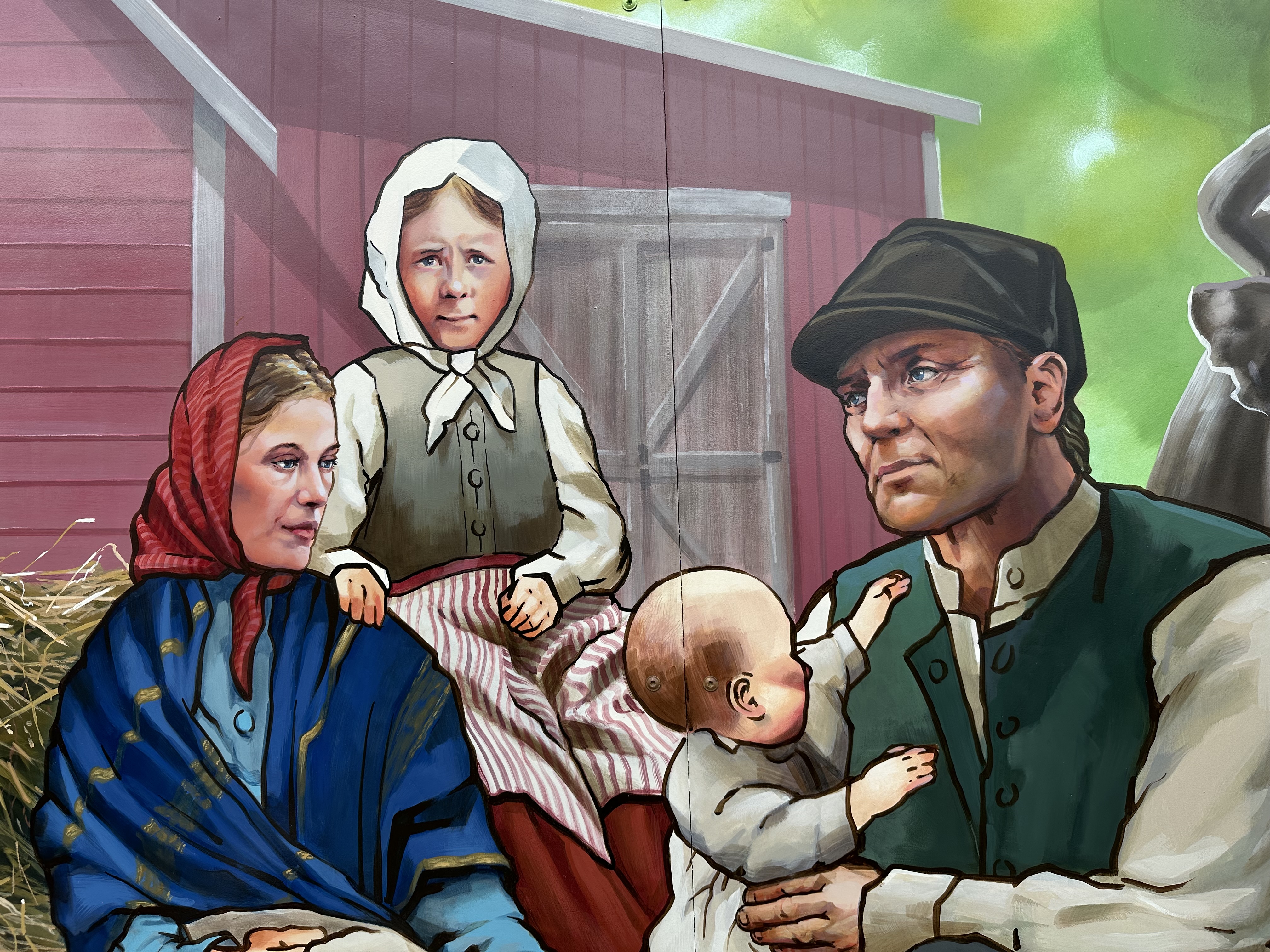
Magnus Jonasson Linnell and the Tipping Point
In the early 1850s, the Chisago Lakes region of Minnesota became a magnet for Swedish immigration from Småland, a mostly rural area of southern Sweden that had been hard hit by overpopulation, hunger and economic strife. These immigrants came for many reasons, but mostly for the inexpensive and fertile land and the free lifestyle promised by the less populated states of the west.
In The Emigrants, the first of Vilhelm Moberg's fictional novels of Swedish emigration from Småland, he writes:
This is the story of a group of people who in 1850 left their homes in Ljuder parish, in the province of Småland, Sweden, and emigrated to North America. They were the first of many to leave their village. They came from a land of small cottages and large families. They were the people of the soil, and they came of a stock which thousands of years had tilled the ground they were leaving.
— Vilhelm Moberg, The Emigrants
Although the names Karl Oskar and Christina Nilsson are wholly a creation of Moberg's imagination and the events of their journey to Chisago County are a composite of many different immigrant experiences, Moberg's story is in fact very real. Those events in those times really happened. They just happened to many Swedes over many journeys to their new homes in Minnesota.
The First Småland Immigrant to Chisago Lakes
In the summer of 1852, several Swedish families lived around the Chisago Lakes, but none of them were from Småland. The first Swede to immigrate from Småland was Magnus Jonasson[1]. In America, his children took the surname Linnell, but there is no record of Magnus adopting that surname. Magnus was referred to as Magnus Jonson.
Magnus was intent on creating a Swedish colony in America and anticipated that his persuasive nature would entice many of his friends and relatives in Sweden to follow him. And indeed that was true. However it took more than just a persuasive personality to draw those many thousand of Kronoberg Swedes to Chisago Lake. For these people to leave Sweden required a rapid spread of news from the New World and almost instantaneous sociological change. And it took more than just a few letters of encouragement from the first emigrant.
In his book The Tipping Point, Malcolm Gladwell defines three kinds of people that enable a dramatic social phenomenon such as this one to happen: a Salesman, a persuader or charismatic person with powerful negotiating skills; a Maven, a person who accumulates knowledge; and a Connector, someone who knows a large numbers of people and who makes introductions.
Gladwell would recognize Magnus as a Salesman. And Magnus appears to be just that when he wrote back to Sweden to attract so many others from parishes in and surrounding his home parish of Furuby to come join him in his new home at Chisago Lake. But two others individuals also contributed to this tipping point phenomenon, his brother Johan Jonasson and his childhood friend Maria Petersdotter.
References
- Moberg, Vilhelm, The Emigrants: A Novel. New York: Simon and Schuster, 1951. Print.